Historical Background
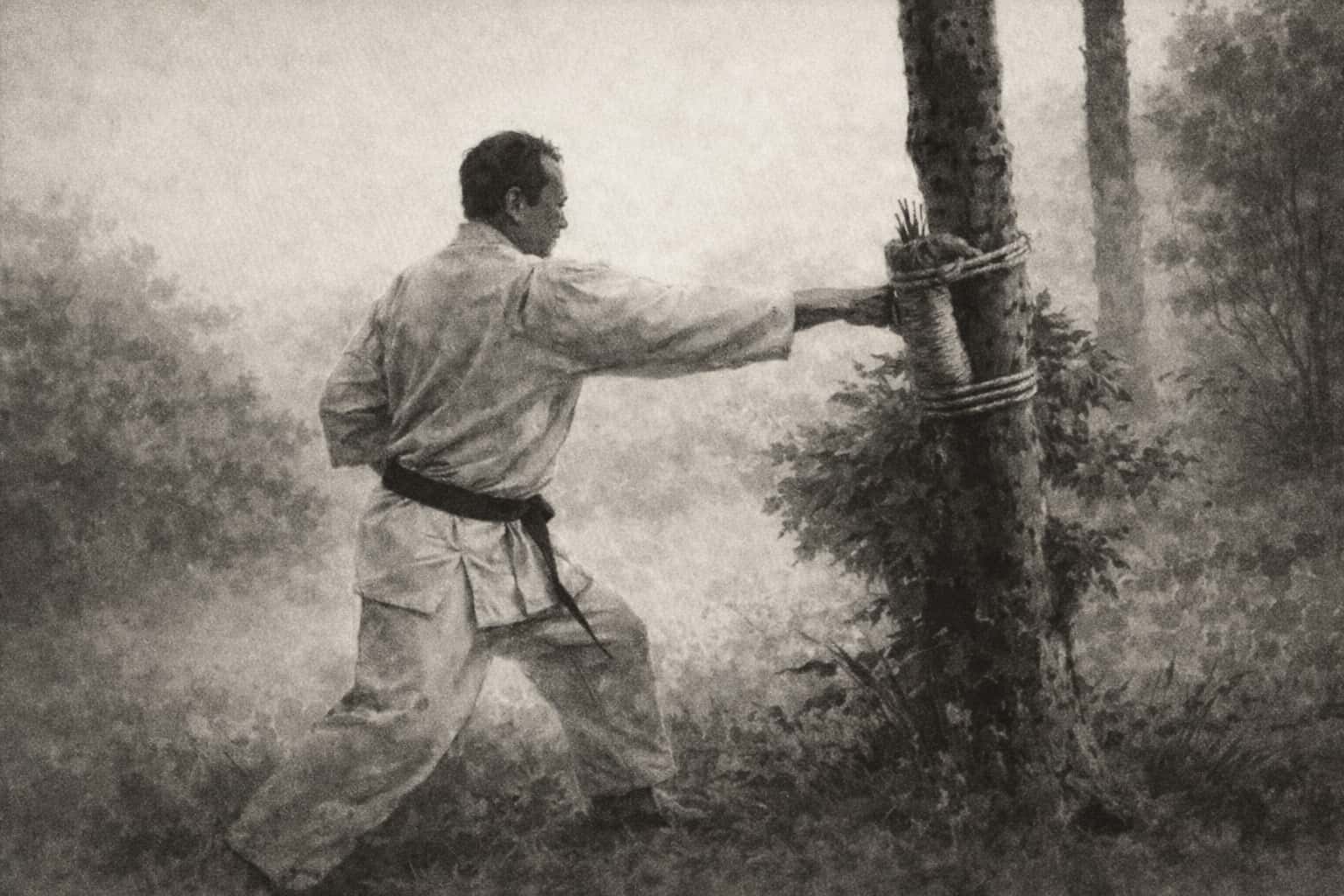
Kyokushin developed within the framework of modern Japanese karate during the mid-20th century. To understand the emergence of the system, one must therefore consider both the martial traditions of Okinawa and the institutionalization of karate in Japan.
The system does not represent an isolated break from earlier tradition, but rather a specific interpretation and further development of already established technical and disciplinary principles.
Okinawa and the Emergence of Karate
Karate developed in Okinawa, where local fighting methods (te) over several centuries were influenced by Chinese martial arts. Sosai Masutatsu Oyama (1923–1994) describes how karate emerged from the encounter between Okinawan indigenous traditions and Chinese combat techniques (Oyama 1959).
During the 18th and 19th centuries, these methods were systematized into regional traditions later referred to as Shuri-te, Naha-te, and Tomari-te. These formed the foundation of modern karate. In his historical accounts, Oyama emphasizes continuity and technical evolution rather than abrupt historical ruptures (Oyama 1959).
It was within this technical and cultural context that modern karate took shape.
Karate in Japan and the Budo Tradition
Karate was introduced to mainland Japan in the early 20th century. Oyama himself describes his training in Shotokan under Gichin Funakoshi and the disciplined environment that characterized early Japanese karate (Oyama 1959).
When karate became established in Japan, it was adapted to the budo tradition. This involved:
- Formalized grading systems
- Standardized dojo etiquette
- Pedagogical structure
- Emphasis on character development
In Vital Karate, Oyama stresses that technique and spiritual discipline are inseparable, and that Zen meditation plays an important role in the development of mental attitude (Oyama 1967).
Karate thus came to be understood not only as a fighting method, but as a disciplined practice within the framework of modern budo.
Post-War Reorientation
After the Second World War, the position of Japanese martial arts changed significantly. Oyama describes the societal upheaval and how his own development took a new direction during this period (Oyama 1959).
During the 1950s, karate began to spread internationally. In the foreword to Advanced Karate, Oyama outlines how karate expanded rapidly beyond Japan during this time (Oyama 1977).
At the same time, he expressed criticism of what he perceived as declining technical standards and superficial instruction within parts of the rapidly growing karate community (Oyama 1977). His criticism was not directed at competition itself, but at training that lacked physical and technical rigor.
This marks an important debate in post-war karate: the question of realism, function, and method.
Realism and Technical Function
In Vital Karate, Oyama emphasizes that karate without breaking practice (tameshiwari) lacks practical verification and therefore risks being reduced to form without substance (Oyama 1967).
He argues that the entire structure of the body must be developed as a weapon, and that technical effectiveness takes precedence over aesthetic movement (Oyama 1967). In later works, he returns to the importance of uniting physical strength with mental discipline, stressing that the ultimate goal of training is self-overcoming (Oyama 1981).
This emphasis on functional testing and disciplined consistency is central to understanding the later development of Kyokushin.
Preconditions for the Emergence of Kyokushin
When Oyama began developing his own system in the 1950s, karate was undergoing rapid expansion and organizational transformation. International spread, increasing competition activity, and varying training standards created an environment in which questions of method, realism, and discipline became central.
Against this historical background, Kyokushin developed as a further evolution within modern karate, with particular emphasis on physical realism, technical function, and disciplinary consistency.
Elements that had previously existed implicitly in tradition — physical testing, technical verification, and mental endurance — were formalized and systematized within Kyokushin training methodology.
The system thus did not arise as a rejection of karate’s historical roots, but as a specific interpretation of them.
The next section examines Oyama’s personal development and how his experiences influenced the form of the system.