Sosai Masutatsu Oyama
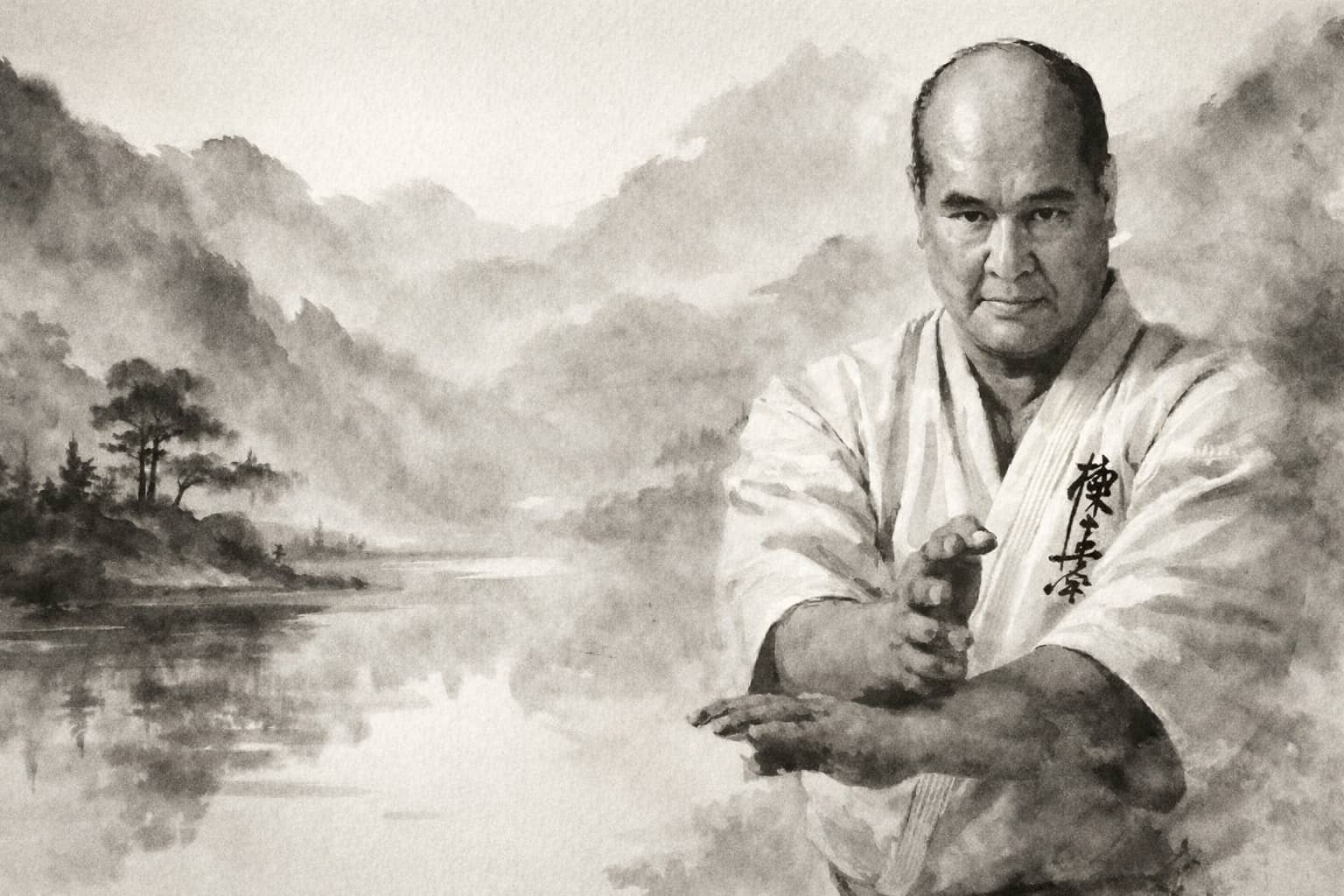
Sosai Masutatsu Oyama (1923–1994) was the founder of Kyokushin. His significance lies not only in technical skill, but in the systematization of karate that he carried out during the 1950s and 1960s. To understand the form of Kyokushin, it is therefore necessary to analyze how his education, discipline, and methodological choices influenced the structure of the system.
Technical Background and Diverse Training
Oyama was born in Korea in 1923 and describes in his own writings how he trained in Chinese kempo at an early age and later continued with Korean martial arts (Oyama 1959).
After traveling to Japan in 1938, he trained in karate under Gichin Funakoshi and also studied judo and Goju-ryu. In What Is Karate?, he outlines the disciplined environment that characterized training in Japan (Oyama 1959).
This diverse background meant that he was exposed to both form-oriented technique (Shotokan), close-range combat and breathing methodology (Goju-ryu), as well as throwing techniques and body control (judo). The later technical synthesis of Kyokushin can be understood in light of this foundation.
Discipline and Ascetic Training
After the Second World War, Oyama describes a period of personal reorientation (Oyama 1959). He undertook two periods of isolated mountain training, where intensive physical exercise was combined with meditation and study.
In his own accounts, this period appears as a test of discipline rather than a mystified transformation (Oyama 1959). The central principle was consistent training, physical endurance, and mental stability.
This experience later influenced Kyokushin’s emphasis on:
- Hard physical conditioning
- Systematic repetition
- Mental endurance
Ascetic discipline did not become a separate ideal, but was integrated into the training method.
Competition and Technical Legitimacy
In 1947, Oyama won the karate division of the first national championship after the war (Oyama 1959). This marked that his technical competence was firmly rooted within the established karate tradition.
During the 1950s, he began demonstrating karate internationally. In Advanced Karate, he describes how karate expanded rapidly on a global scale during this period (Oyama 1977).
At the same time, he expressed criticism of what he perceived as technical superficiality and lack of precision within parts of the growing karate community (Oyama 1977). His criticism was directed at methodology, not at expansion itself.
Physical Verification and Methodological Consistency
A central aspect of Oyama’s development was his emphasis on the physical verification of technique. In Vital Karate, he argues that breaking practice (tameshiwari) is a necessary test of technical effectiveness and bodily structure (Oyama 1967).
The value of technique should not be determined by formal correctness alone, but by its functional consequence. This perspective became a foundational element in the training structure of Kyokushin.
The principle that the body must be developed as an integrated instrument recurs consistently throughout his writings (Oyama 1967; Oyama 1981).
Organizational Formalization
In 1953, Oyama opened his first dojo in Tokyo. In the years that followed, a training culture developed that emphasized:
- Hard kumite
- Continuous physical conditioning
- Disciplinary structure
- Technical verification
In 1964, the organization was formalized under the name International Karate Organization Kyokushinkaikan.
The name Kyokushin — “ultimate truth” — expressed the ambition to unite technical function, discipline, and personal development within a coherent system.
Concluding Analysis
Oyama’s significance can be summarized in four systematic contributions:
- A synthesis of multiple karate traditions
- Integration of ascetic discipline into the training method
- Emphasis on physical verification of technique
- Organizational structuring of a coherent system
Kyokushin thus appears not as a spontaneous expression of individual strength, but as the result of a deliberate and methodical structuring of karate during a historical period marked by expansion and transformation.
The next section addresses the system’s foundational principles and the conceptual structure that shaped Kyokushin’s identity.