System Principles
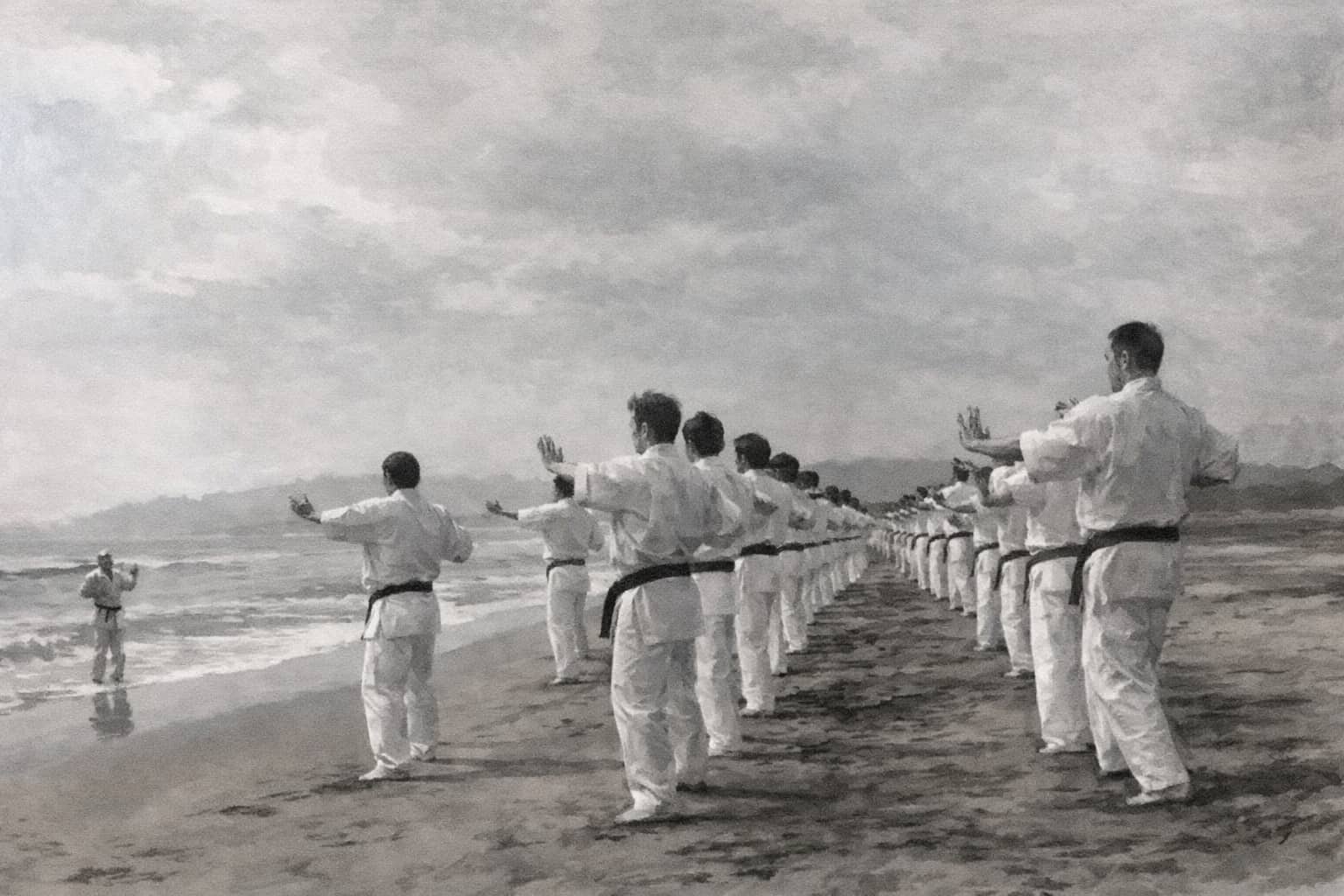
The historical and biographical factors discussed in the previous chapters — the development of karate, the post-war methodological debate, and Sosai Masutatsu Oyama (1923–1994)’s emphasis on physical verification — are concretized in Kyokushin as structural system principles.
These principles organize the training method and define the internal logic of the system. They should be understood here as functional and methodological, not as philosophical or normative ideals. Their purpose is to ensure technical consistency and structural coherence.
1. Functional Verification
A recurring premise in Oyama’s writings is that technique must be tested through concrete application. In Vital Karate, he emphasizes that breaking practice (tameshiwari) functions as a test of technical effectiveness and of the developed bodily structure (Oyama 1967).
The value of technique is therefore not determined solely by formal correctness, but by its function under load.
This principle is realized through:
- Full-contact kumite
- Systematic body conditioning
- Practical testing of strikes and kicks
Verification is a methodological component of the system, not a separate activity.
2. Progressive Load
Kyokushin is structured around the gradual increase of physical and technical load. In his autobiographical accounts, Oyama describes training as long-term and cumulative (Oyama 1959).
Progression occurs through:
- Increased repetition volume
- Increased intensity in kumite
- Gradual technical complexity
Load functions as a structuring element in the system’s developmental model.
3. Structural Body Integration
In several works, Oyama stresses that power is not generated through isolated muscle use, but through coordination of the body as a whole (Oyama 1967; Oyama 1981).
This implies that:
- Stance, hip rotation, and breathing are integrated
- Power transfer occurs through stable structure
- Economy of movement is prioritized
The system therefore organizes training so that the entire body develops as a coherent unit.
4. Consistency Between Principle and Practice
A central characteristic of the system is that its technical principles are reflected in its training format. The emphasis on function and verification expressed in Oyama’s texts is manifested in the system’s full-contact training and conditioning components (Oyama 1977).
There is thus structural consistency between:
- Stated technical norms
- Chosen training methods
- Organizational structure
This alignment is essential for the system to function coherently.
5. Integrated System Structure
Kyokushin is organized around four primary training components:
- Kihon
- Kata
- Kumite
- Tameshiwari
These are not separate disciplines, but interdependent parts of a unified model.
- Kihon develops fundamental structure.
- Kata formalizes movement patterns.
- Kumite tests technique under resistance.
- Tameshiwari verifies power generation.
The system principles are realized through the interaction of these components.
Summary
Kyokushin’s system principles can be summarized in four structural elements:
- Functional verification
- Progressive load development
- Structural body integration
- Consistency between norm and method
These principles describe how the system is organized. The deeper philosophical or normative dimensions of these concepts are addressed in the Philosophy section.