The Knockdown System
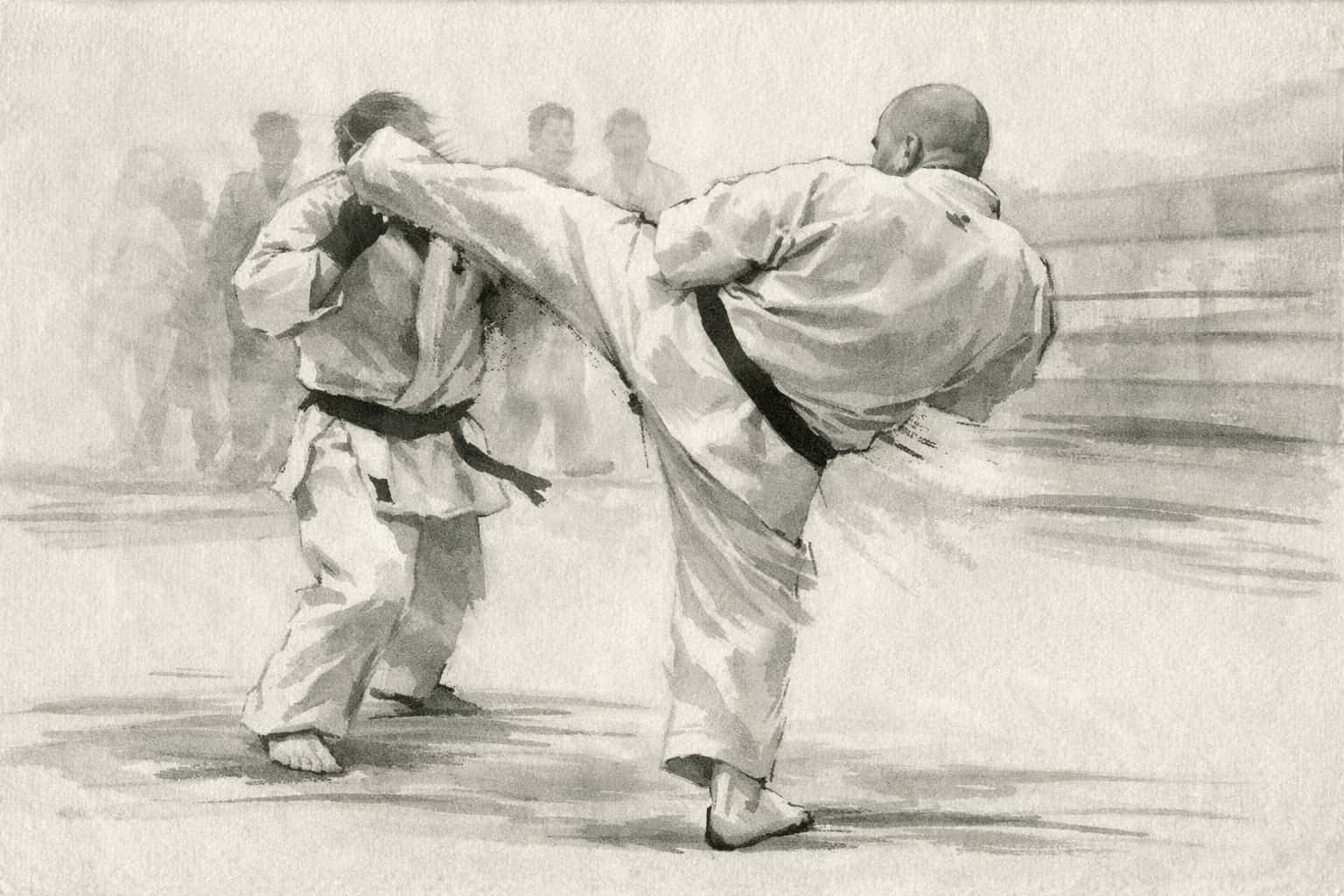
Within the system structure previously described — where kihon, kata, kumite, and tameshiwari function as integrated components — knockdown represents the competitive application of the principle of functional verification.
The system principles discussed in earlier chapters, particularly progressive load and physical testing, are here concretized in an institutionalized competition framework.
It is important, however, to distinguish between:
- The training principles formulated in the works of Sosai Masutatsu Oyama (1923–1994)
- The competition rules later formalized organizationally
Oyama’s books primarily address principles of full contact, physical verification, and technical consistency (Oyama 1967; Oyama 1977). The modern knockdown format is an organizational concretization of these principles, not a complete representation of the system as a whole.
Principled Foundation in Oyama’s Writings
In Vital Karate, Oyama emphasizes that karate must be tested through actual physical load and that technical effectiveness must not be reduced to formal aesthetics (Oyama 1967).
In Advanced Karate, he criticizes training that lacks technical precision and practical relevance (Oyama 1977).
These formulations provide the principled foundation for a competition format in which:
- Physical contact is permitted
- Endurance and conditioning are decisive factors
- Technique is tested under resistance
The specific rule structure, however, is not described in detail in these works.
Rule Structure and Organizational Development
During the late 1960s and early 1970s, national and international tournaments were organized within the International Karate Organization (IKO). In this context, a competition format developed that later came to be known as knockdown.
The format is generally characterized by:
- Full contact to the body and legs
- Permitted kicks to the head
- No punches to the head with a closed fist
- Victory by knockdown or judges’ decision
These rules emerged from organizational practice and competitive development rather than from detailed prescriptions in Oyama’s books.
Following organizational changes after 1994, minor variations in rules have appeared among different organizations, but the fundamental structure has largely been preserved.
Relation to System Principles
The knockdown format can be understood as a consistent application of the system principles previously discussed:
- Functional verification
- Progressive load
- Structural body integration
By allowing full physical engagement within controlled boundaries, a competitive environment is created in which technical structure and conditioning become directly decisive.
The format is thus aligned with the methodology described in Oyama’s works, even though the rule structure itself developed organizationally.
Delimitation from the System as a Whole
Knockdown is a competition format, not the entirety of the Kyokushin system.
The system also includes:
- Foundational training (kihon)
- Formalized movement patterns (kata)
- Physical verification outside competition (tameshiwari)
The competition format represents only the competitive dimension of the system’s practical application.
Structural Significance
Within the institutional framework of Kyokushin, knockdown serves three functions:
- Testing physical endurance
- Testing technical structure under load
- Public verification of the system’s competitive capacity
The competition format therefore reinforces the structural principles of the system without defining its full scope.
Summary
The knockdown system developed organizationally within the IKO during the 1960s and 1970s as a competition format consistent with the principles of full contact and physical verification emphasized by Oyama in his writings (Oyama 1967; Oyama 1977).
The rules constitute an institutional concretization of these principles, not a comprehensive description of Kyokushin as a training system.