Organizations
The previous chapters have addressed Kyokushin as a system: its historical background, system formation, principles, structure, and competition format. This chapter examines the institutional dimension — how the system has been organized and administered.
It is essential to distinguish between:
- Kyokushin as a training system
- Organizations that administer and manage the system
Organizations regulate gradings, instructor licensing, competitions, and international coordination. They constitute administrative structures surrounding a shared technical heritage.
International Karate Organization under Oyama
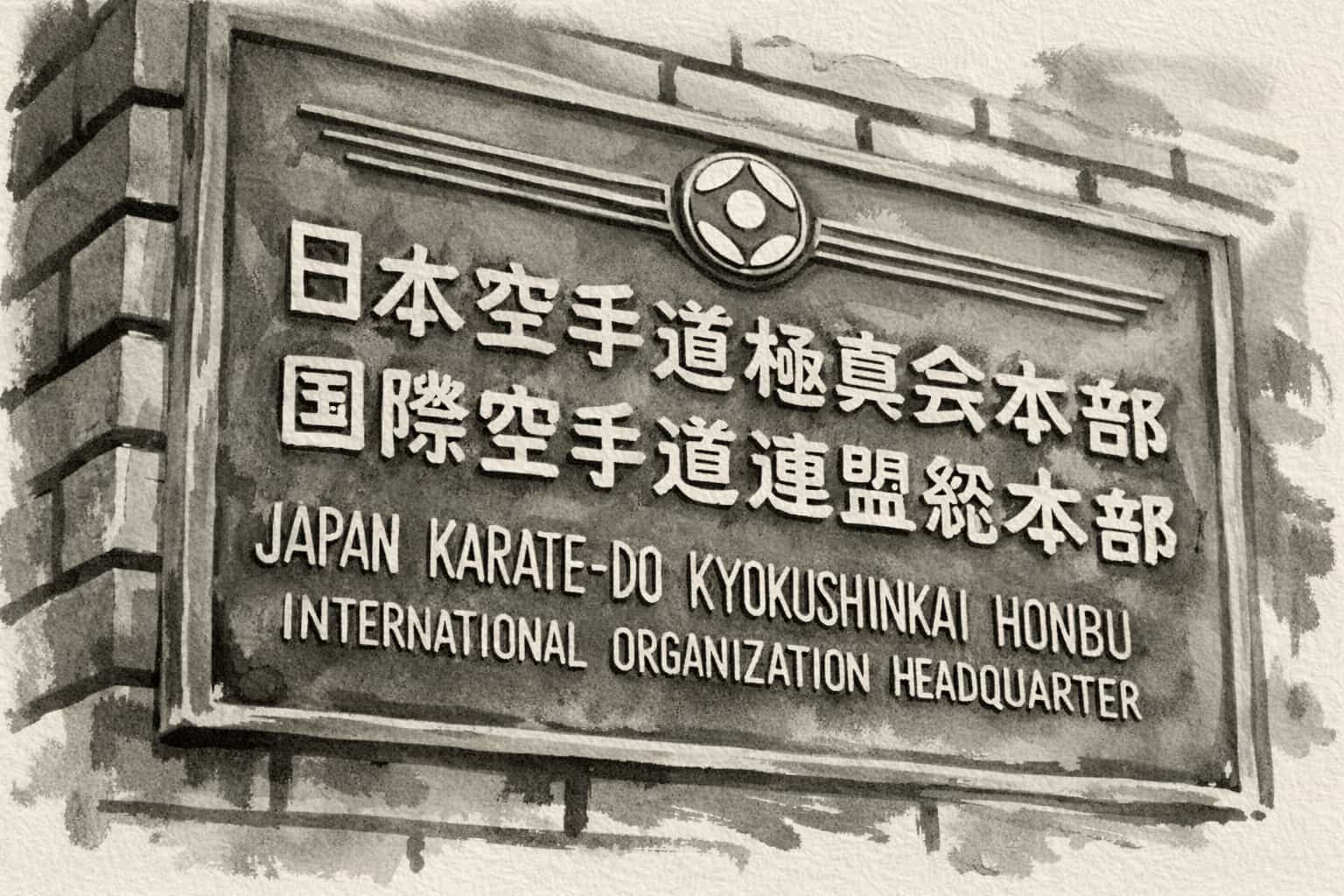
In 1964, Sosai Masutatsu Oyama (1923–1994) formalized the International Karate Organization Kyokushinkaikan (IKO), with the Honbu Dojo in Tokyo as its center.
During Oyama’s lifetime, Kyokushin was administratively unified within this organization. In his own works, the focus is primarily on method, discipline, and technical structure, while organizational matters receive limited attention (Oyama 1967; Oyama 1977).
During this period, IKO functioned as:
- Central grading authority
- International coordinating body
- Organizer of national and international championships
In practice, system and organization largely coincided during this phase.
Institutional Differentiation after 1994
Following Oyama’s passing in 1994, organizational changes occurred. Leadership issues and administrative disagreements led to the establishment of several independent international organizations.
This development represented institutional differentiation rather than dissolution of the training system. The fundamental structure of Kyokushin — kihon, kata, kumite, and tameshiwari — remained largely intact, although organizational and administrative variations emerged.
The organizations came to:
- Administer their own grading systems
- Organize their own international championships
- Appoint their own technical committees
The division should therefore be understood as administrative rather than technical.
Representative International Organizations
Several international organizations with historical roots in the original IKO structure are active today. The following list is representative but not exhaustive:
- International Karate Organization (IKO Kyokushinkaikan)
- World Karate Organization (WKO Shinkyokushinkai)
- International Federation of Karate (IFK)
- IKO Matsushima
- IKO Tezuka Group
- Kyokushin-kan International
- Kyokushin World Federation (KWF)
These organizations maintain their own administrative and leadership structures while referring to Kyokushin as their technical foundation.
Variations exist in competition rules, organizational models, and international frameworks, but the overarching system principles are largely shared.
Institutional and Technical Levels
For analytical clarity, it is useful to distinguish between two levels:
Institutional Level
- Organization
- Leadership
- Competition administration
- Grading management
Technical Level
- Training methodology
- System principles
- Structure (kihon, kata, kumite, tameshiwari)
The organizational divisions that emerged after 1994 primarily affect the institutional level and do not necessarily imply fundamental changes in the system’s technical structure.
Structural Significance
Organizations serve three primary functions within Kyokushin:
- Administrative coordination
- Quality assurance of grading systems
- Institutionalization of competitive activity
They therefore function as forms of system governance rather than as alternative training systems.
Summary
During Oyama’s lifetime, Kyokushin was administratively unified within the IKO. After 1994, multiple independent international organizations emerged with shared historical roots.
This institutional pluralism does not necessarily alter the system’s technical foundation, but it does influence its organizational and competitive expressions.
Organizations should therefore be understood as administrative structures surrounding a shared training system.