道場訓
Dojo Kun
Introduction
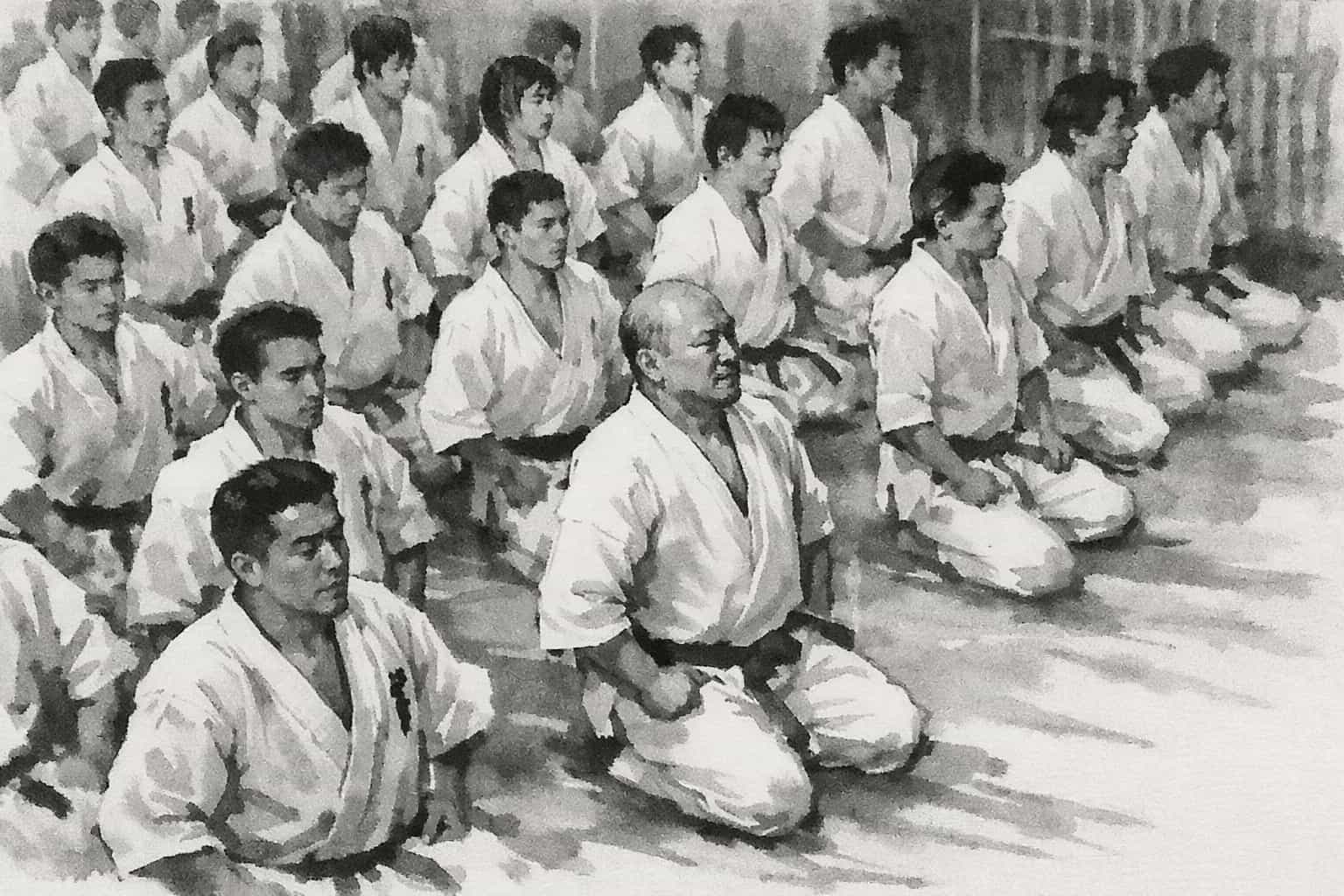
Dojo Kun consists of the guidelines traditionally recited at the end of training in Kyokushin.
The text is attributed to Sosai Masutatsu Oyama (1923–1994) and functions as a disciplinary declaration summarizing the norms and ideals intended to guide the practitioner’s training and conduct.
Dojo Kun is not a theoretical philosophical treatise, but a normative formulation intended to be enacted in practice.
Japanese Original Text
一、吾々は心身を錬磨し確固不抜の心技を極めること。
一、吾々は武の神髄を極め機に発し感に敏なること。
一、吾々は質実剛健を以て克己の精神を涵養すること。
一、吾々は礼節を重んじ長上を敬し粗暴の振舞いを慎むこと。
一、吾々は神仏を尊び謙譲の美徳を忘れざること。
一、吾々は智性と体力とを向上させ事に臨んで過たざること。
一、吾々は生涯の修行を空手の道に通じ極真の道を全うすること。
Romaji (Hepburn)
Hitotsu, wareware wa shinshin o renma shi kakko fubatsu no shingi o kiwameru koto.
Hitotsu, wareware wa bu no shinzui o kiwame ki ni hasshi kan ni bin naru koto.
Hitotsu, wareware wa shitsujitsu gōken o motte kokki no seishin o kanyō suru koto.
Hitotsu, wareware wa reigi o omonji chōjō o keishi sobō no furumai o tsutsushimu koto.
Hitotsu, wareware wa shinbutsu o tattobi kenjō no bitoku o wasurezaru koto.
Hitotsu, wareware wa chisei to tairyoku to o kōjō sase koto ni nozonde ayamataru koto naki koto.
Hitotsu, wareware wa shōgai no shugyō o karate no michi ni tsūji Kyokushin no michi o mattō suru koto.
Official English Version
We will train our hearts and bodies for a firm and unwavering spirit.
We will pursue the true meaning of the martial way, so that in time our senses may be alert.
With true vigor, we will seek to cultivate a spirit of self-denial.
We will observe the rules of courtesy, respect our seniors, and refrain from violence.
We will follow our religious principles and never forget the virtue of humility.
We will look upwards to wisdom and strength, not seeking other desires.
All our lives, through the discipline of karate, we will seek to fulfill the true meaning of the Kyokushin way.
Linguistic Structure
Each principle begins with 「一、Hitotsu」, which literally means “One.”
This indicates that each statement is independent and equal in importance.
The formulations consistently end with 「こと」 (koto), giving the text the character of a vow or normative rule rather than a descriptive statement.
The structure is that of a series of disciplinary commitments expressed in collective form (吾々は – wareware wa, “we”).
Key Concepts
Several key terms are central to understanding Dojo Kun:
- 心身 (shinshin) – body and mind as a unified whole
- 克己 (kokki) – self-mastery or overcoming oneself
- 修行 (shugyō) – lifelong disciplined training
- 礼節 (reigi) – courtesy and proper conduct
- 質実剛健 (shitsujitsu gōken) – simplicity, strength, and robust character
These terms are characteristic of Japanese budo tradition and express disciplinary ideals rather than abstract metaphysical principles.
Theoretical Context
Dojo Kun situates Kyokushin within a broader budo tradition in which:
- Physical training and mental discipline are integrated
- Self-overcoming is central
- Hierarchy and respect regulate relationships within the dojo
The formulations are normative and intended to function as practical guidelines.
They do not constitute a systematic philosophical program and contain no developed theoretical argumentation.
Function Within Kyokushin
Dojo Kun fulfills several functions:
- Clarifying disciplinary norms
- Articulating ideals of self-control
- Regulating relationships within the dojo
- Emphasizing lifelong training
The text is traditionally recited collectively, reinforcing its function as a shared declaration rather than an individual reflection.
Delimitation
Dojo Kun should not be understood as:
- A religious creed
- An esoteric doctrine
- A substitute for practical training
Its function is to articulate disciplinary ideals that are tested and realized through daily practice.
Summary
Dojo Kun is a normative text within Kyokushin summarizing central disciplinary and ethical ideals.
Through its linguistic structure and content, it expresses a budo tradition in which self-discipline, respect, and lifelong training are central.
Its significance lies not in symbolic theory, but in its function as practical guidance for conduct and training.