一撃必殺
Ichi Geki Hissatsu
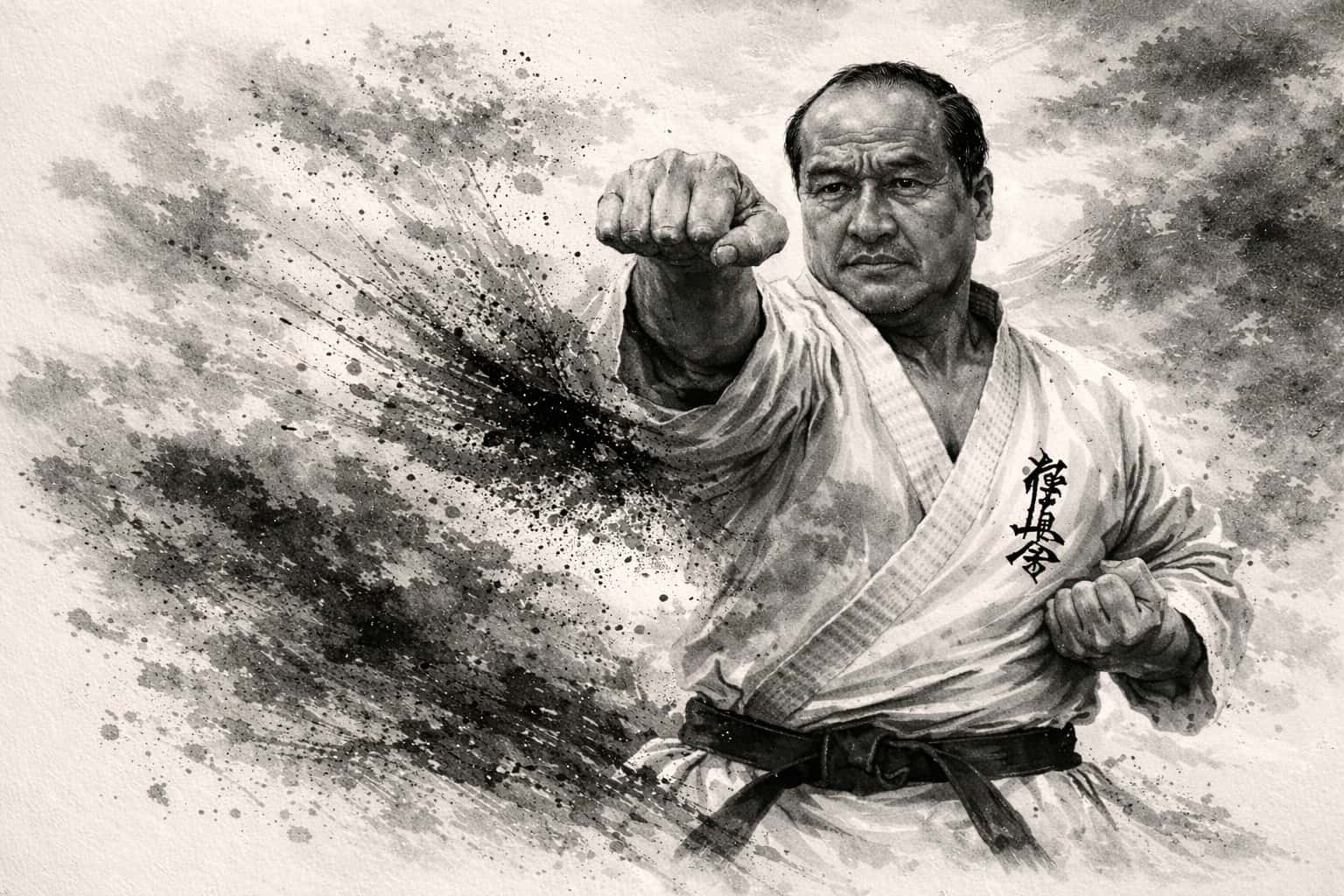
Introduction
Ichi Geki Hissatsu (一撃必殺) is a classical budō expression commonly translated as:
“One strike – certain death”
or
“One strike – decisive effect”
The phrase appears in several Japanese martial traditions and is used within Kyokushin to describe a technical and mental standard.
It should not be understood literally as an encouragement of lethal violence, but as a principle of complete technical precision and determination.
Linguistic Analysis
一 (ichi) – one
撃 (geki) – strike, attack
必 (hitsu) – inevitably, without exception
殺 (satsu) – to kill, to destroy
Literally, the expression means:
“One strike, necessarily killing.”
In modern budō contexts, however, it is used normatively rather than literally.
Historical Context
The expression has historical roots in classical Japanese combat traditions, where techniques were developed for real-life combat situations.
Within modern karate and budō, its meaning has been reinterpreted to refer to:
- Decisive effectiveness
- Total concentration
- Complete presence in every technique
The concept is therefore technical rather than literal.
Ichi Geki Hissatsu in Oyama’s Writings
Although the phrase is not treated as a separate theoretical chapter in the English-language books of Sosai Masutatsu Oyama (1923–1994), its principle recurs in his view of technique and training.
In This Is Karate, Oyama emphasizes the importance of concentrating power through correct structure, timing, and body control, and insists that techniques must be functional rather than aesthetic. He stresses that karate must be practically effective and not reduced to form or sportified movement.
In Vital Karate, he describes how the entire body must be developed into an integrated weapon, and how power must be concentrated at precisely the right moment. Technique must be complete, not fragmented.
In Mas Oyama’s Essentials of Karate, he explains how the angle of impact, acceleration, and unified body force determine effectiveness, particularly in tameshiwari. Power must be properly focused and correctly directed to become effective.
These discussions express the technical core of Ichi Geki Hissatsu: every technique should be executed with complete integrity and determination.
Ichi Geki Hissatsu in Kyokushin
Within Kyokushin, the principle implies that:
- Every technique must be performed with maximum precision
- Movements should not be half-hearted
- Strikes and kicks must have functional integrity
- The practitioner must act with mental decisiveness
It is not about causing fatal harm, but about ensuring that every movement is technically complete and realistically executed.
The principle is closely linked to Kyokushin’s emphasis on:
- Full contact
- Realism
- Structural body integration
- Practical verification
Relation to Training
Ichi Geki Hissatsu is tested through:
- Kihon (basic techniques)
- Kumite (sparring)
- Tameshiwari (breaking)
In training, it implies:
- Not neglecting technical detail
- Not relying on point systems
- Striking with intention and structure
- Remaining committed to one’s action
The principle is therefore connected to technical discipline rather than aggression.
Relation to Other Concepts
Ichi Geki Hissatsu is closely related to:
- 修行 (Shugyō) – long-term disciplined training
- 克己 (Kokki) – self-overcoming under pressure
- 押忍の精神 (Osu no Seishin) – the mentality of perseverance
If Shugyō is the method and Kokki the inner discipline, Ichi Geki Hissatsu represents the technical standard.
Delimitation and Misunderstandings
Ichi Geki Hissatsu does not mean:
- That every training session aims to injure
- That violence is idealized
- That lethal force is the objective
It is a principle of:
- Decisive focus
- Complete technique
- Mental determination
In modern Kyokushin, the expression is understood as an ideal of effectiveness, not as a literal doctrine of death.
Summary
Ichi Geki Hissatsu expresses a technical norm within Kyokushin:
Every technique should be complete, decisive, and functional.
The principle emphasizes concentration, realism, and technical integrity.
In Oyama’s teachings, it appears through the emphasis on concentrated power, correct structure, and practical effectiveness.
Its meaning lies not in literal interpretation, but in the requirement that every movement be executed with full presence and responsibility.