Grading Ethics
Introduction
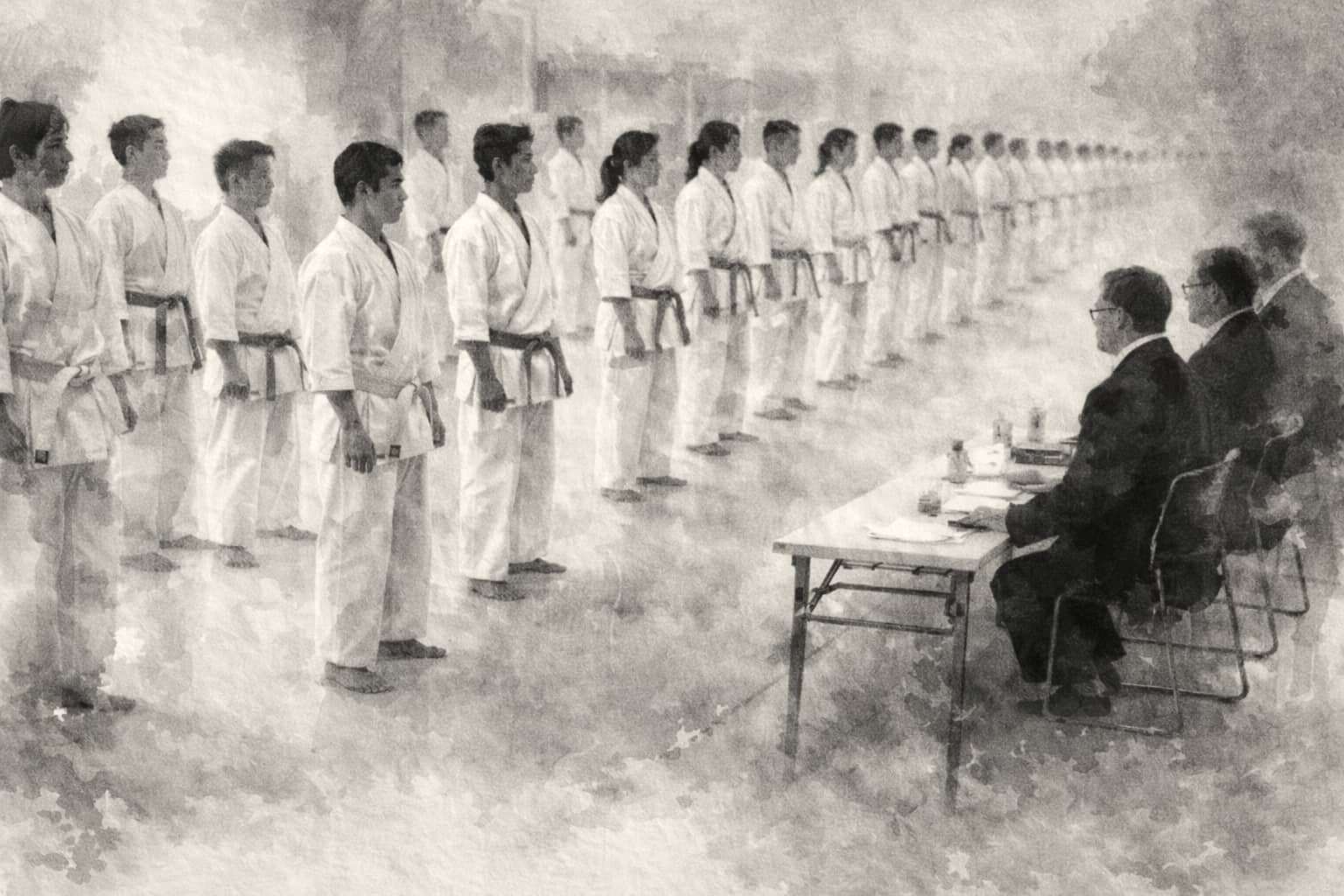
Grading within Kyokushin is an examination of both technique and character.
In his writings, Sosai Masutatsu Oyama (1923–1994) emphasizes that karate is not about symbols or titles, but about genuine development through discipline and training. Rank is therefore recognition of progression, not a goal in itself.
The Meaning of Rank According to Oyama
In What Is Karate? and This Is Karate, Oyama repeatedly stresses that technique without spirit has no value. This principle applies equally to rank.
A grade represents:
- Documented technical level
- Physical capacity
- Mental endurance
- Self-control
However, rank has meaning only if it corresponds to actual ability.
In Oyama’s view, karate must be proven through action rather than through title.
Black Belt – The Beginning, Not the End
In This Is Karate, Oyama emphasizes that the black belt does not signify completion, but the beginning of more profound training.
It implies:
- Increased responsibility
- Deepened discipline
- Expectation of exemplary conduct
A higher rank does not confer prestige, but the responsibility to uphold standards and integrity.
Relation to Shugyō
The Dojo Kun concludes with the phrase:
生涯の修行 (lifelong training)
This underscores that progression is never complete.
Grading is a step within shugyō—the continuous process of disciplined training.
It tests:
- Endurance under strain
- Stability under pressure
- Consistent training over time
Relation to Kokki
The concept of 克己 (kokki)—to overcome oneself—is central in the context of grading.
An examination does not test technical skill alone, but also how the practitioner:
- Controls fear
- Manages fatigue
- Maintains discipline
- Demonstrates respect
Rank without self-mastery is incomplete within the disciplinary framework of Kyokushin.
Delimitation
According to Oyama’s teaching, grading is not:
- A social reward
- A final destination
- Proof of superiority
It is a step of responsibility within an ongoing process.
Summary
Grading ethics in Kyokushin implies that:
- Rank must correspond to real ability
- The black belt marks the beginning of deeper discipline
- Character is as important as technique
- Training continues after each grade
Grading is part of shugyō—not its conclusion.