
Musubi-dachi
Name: Musubi-dachi (結び立ち)
English: Open-toes stance with the heels together
Introduction
Musubi-dachi is a basic standing position in which the heels are held together and the toes open outward.
In Masutatsu Oyama’s system it corresponds to the open-toes stance or open foot stance. It is primarily used for formal order, gathering, opening, closing, and transitions in training.
The stance is simple but important because it shows how the foot angle can open while the body remains upright, symmetrical, and collected.
Definition
In Musubi-dachi:
- the heels remain together
- the toes open outward to each side
- the body stays upright
- weight is carried evenly between right and left
- the position serves as a formal basic, starting, closing, or transitional stance
Oyama’s descriptions emphasize heels together, toes outward, and a straight body. Some instructions give an opening of about 60 degrees. Treat this as a guideline: the feet should be clearly open without forcing the knees, hips, or posture out of a neutral line.
Technical figure
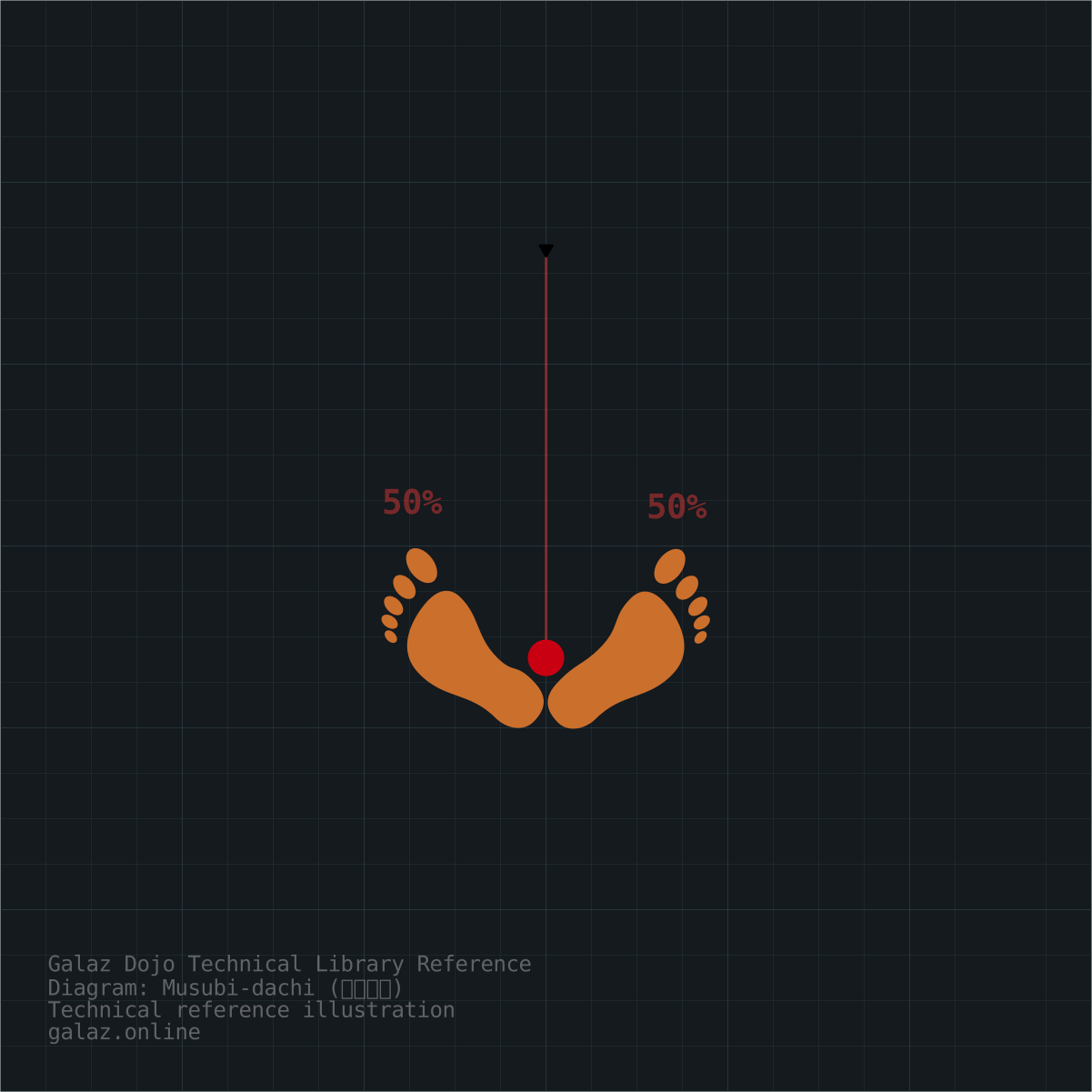
The figure shows the heels together, toes opened outward, and even weight distribution. Markings such as 50/50 are pedagogical aids rather than exact measurements attributed to Oyama.
Structure and form
Feet
Keep the heels together and open the toes outward naturally. Do not make the angle so large that the knees or hips are forced.
Legs
Keep the legs straight but not rigidly locked. Let the knees follow the direction of the feet without collapsing inward or being pushed outward.
Hips
Keep the hips neutral over the narrow base. Do not tilt or shift the pelvis.
Trunk and spine
Keep the spine upright and the trunk naturally collected without unnecessary tension.
Shoulders, arms, and hands
Relax the shoulders. Arm and hand position depends on the formal context, kata, kihon, or transition; it does not define the stance itself.
Gaze
Keep the head upright and the gaze forward.
Weight distribution
For teaching purposes:
- 50% right
- 50% left
There is no intended forward or rear bias.
Center of gravity and balance
Keep the center of gravity over the collected base and the body on a clear vertical line. Musubi-dachi develops controlled balance and formal readiness rather than heavy power generation or active fighting stability.
Technical purpose
Musubi-dachi develops:
- symmetrical posture
- even weight distribution
- understanding of an open foot angle
- knee and hip control in a narrow base
- formal readiness for opening, closing, or transition
Use
Basic training
Use it to train posture, even weight, and ordered foot placement.
Kihon / Idō geiko
It is normally a gathering, starting, or transitional stance rather than a main power stance.
Kata
It may appear at the beginning, end, or during transitions depending on the kata.
Kumite / application
It is not an active kumite stance, although it may appear in formal moments before or after fighting practice.
Technical key points
- keep the heels together
- open the toes clearly but naturally
- remain upright
- distribute weight evenly
- keep the knees aligned with the feet
- keep the hips neutral
- relax the shoulders
- look forward
Common errors
- opening the toes too little or too far
- separating the heels
- using unequal foot angles
- allowing the knees to collapse inward
- shifting or tilting the hips
- leaning the body
- creating unnecessary tension
Comment
Musubi-dachi is a simple but important stance in Kyokushin. By joining the heels and opening the toes it creates a clear transition from a closed standing form to an open foot structure. Its value lies in order, posture, direction, and formal readiness.