
Zenkutsu-dachi
Name: Zenkutsu-dachi (前屈立ち)
English: Forward stance / forward-leaning stance
Introduction
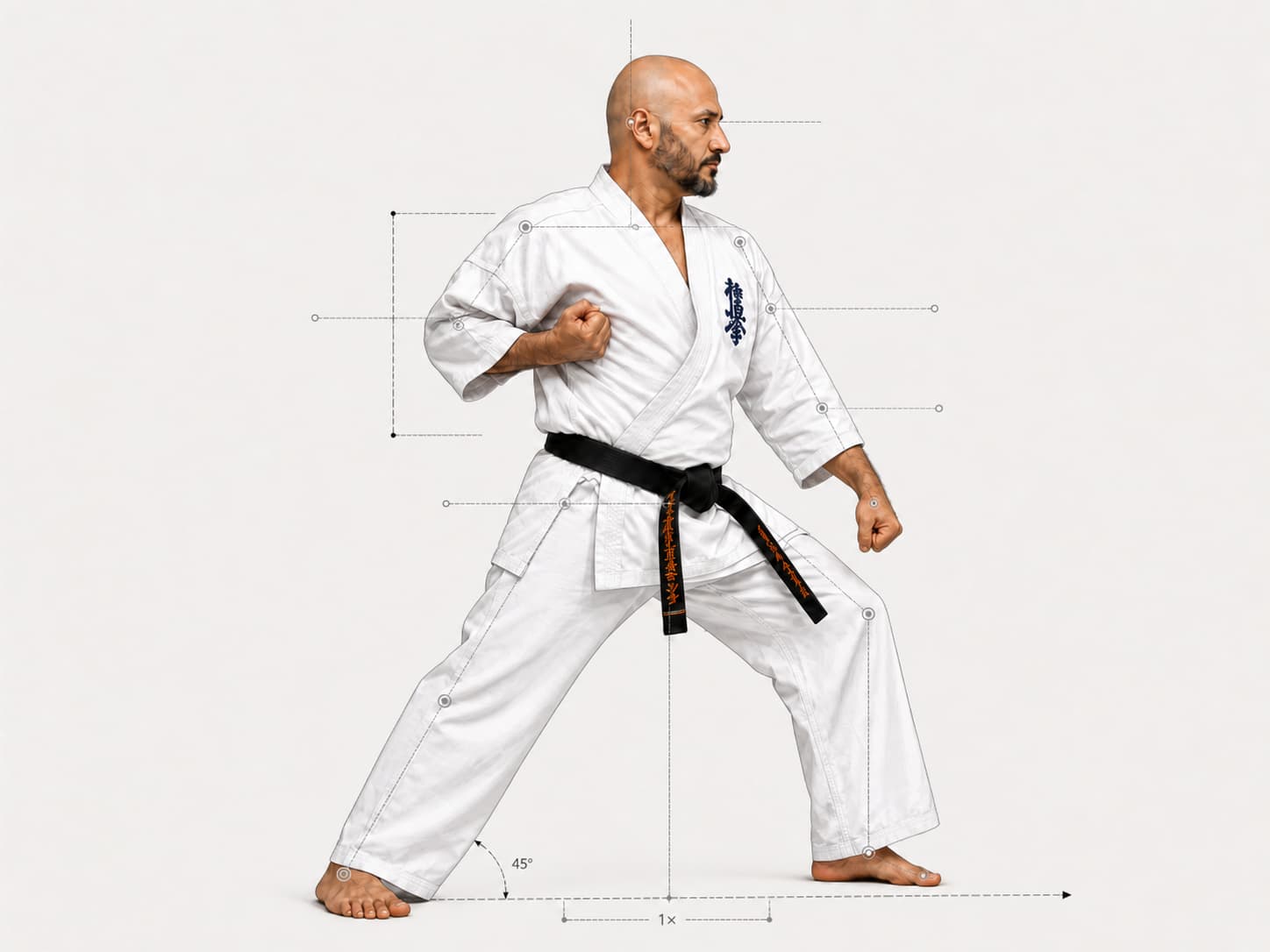
Zenkutsu-dachi is a forward-directed basic stance in which the front knee bends, the rear leg stays straight or strongly extended, and the body is organized to carry technique forward.
It is a central stance in Kyokushin kihon, idō geiko, and kata.
Definition
- one foot is clearly in front of the other
- the front foot points forward
- the rear foot turns slightly outward
- the front leg carries the main forward load
- the rear leg stabilizes and supports forward drive
- the body remains directed forward without collapsing at the waist
Technical figure
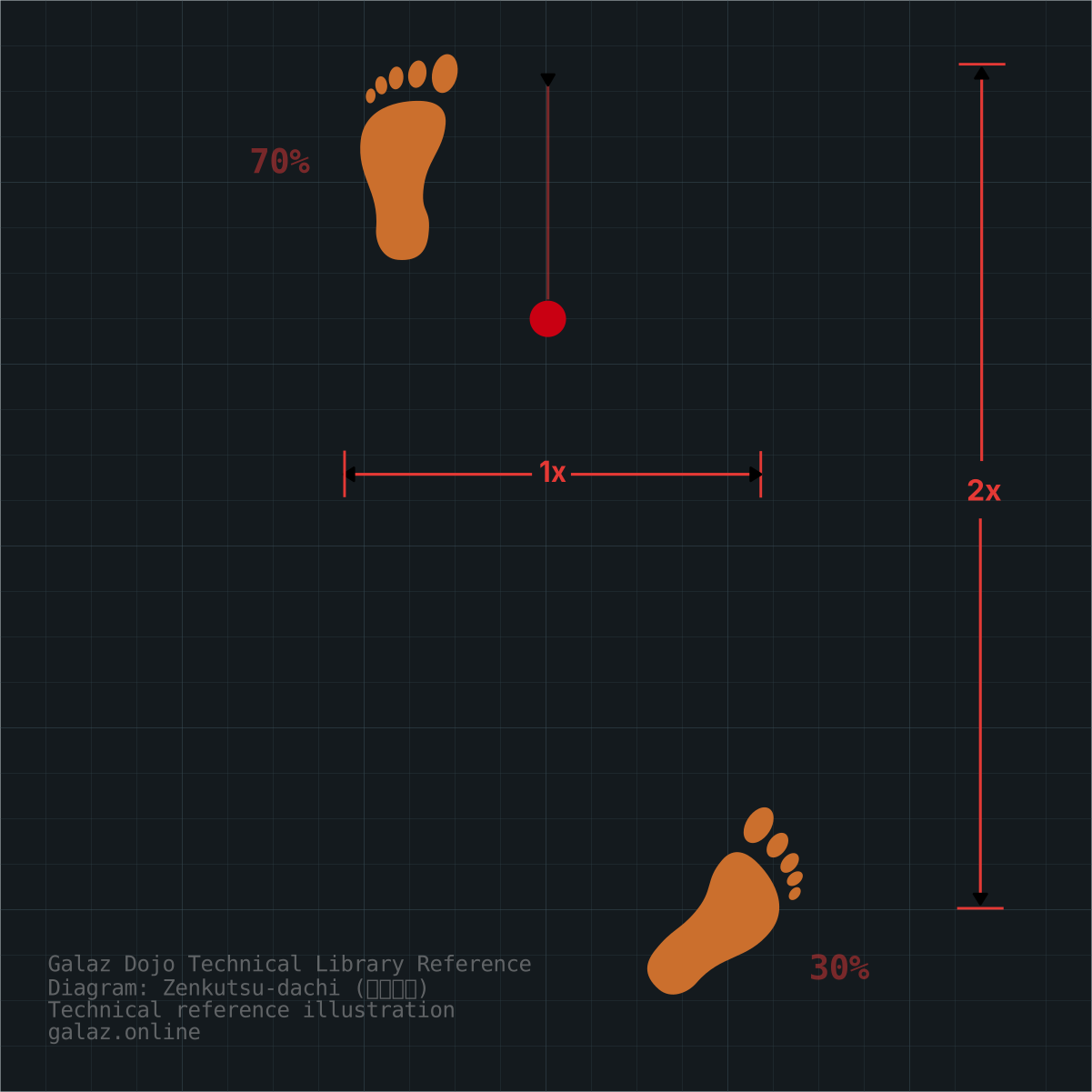
The diagram uses approximately 1× side width, 2× length, and 70% front / 30% rear as pedagogical guidelines rather than exact measurements attributed to Oyama.
Structure and form
Feet
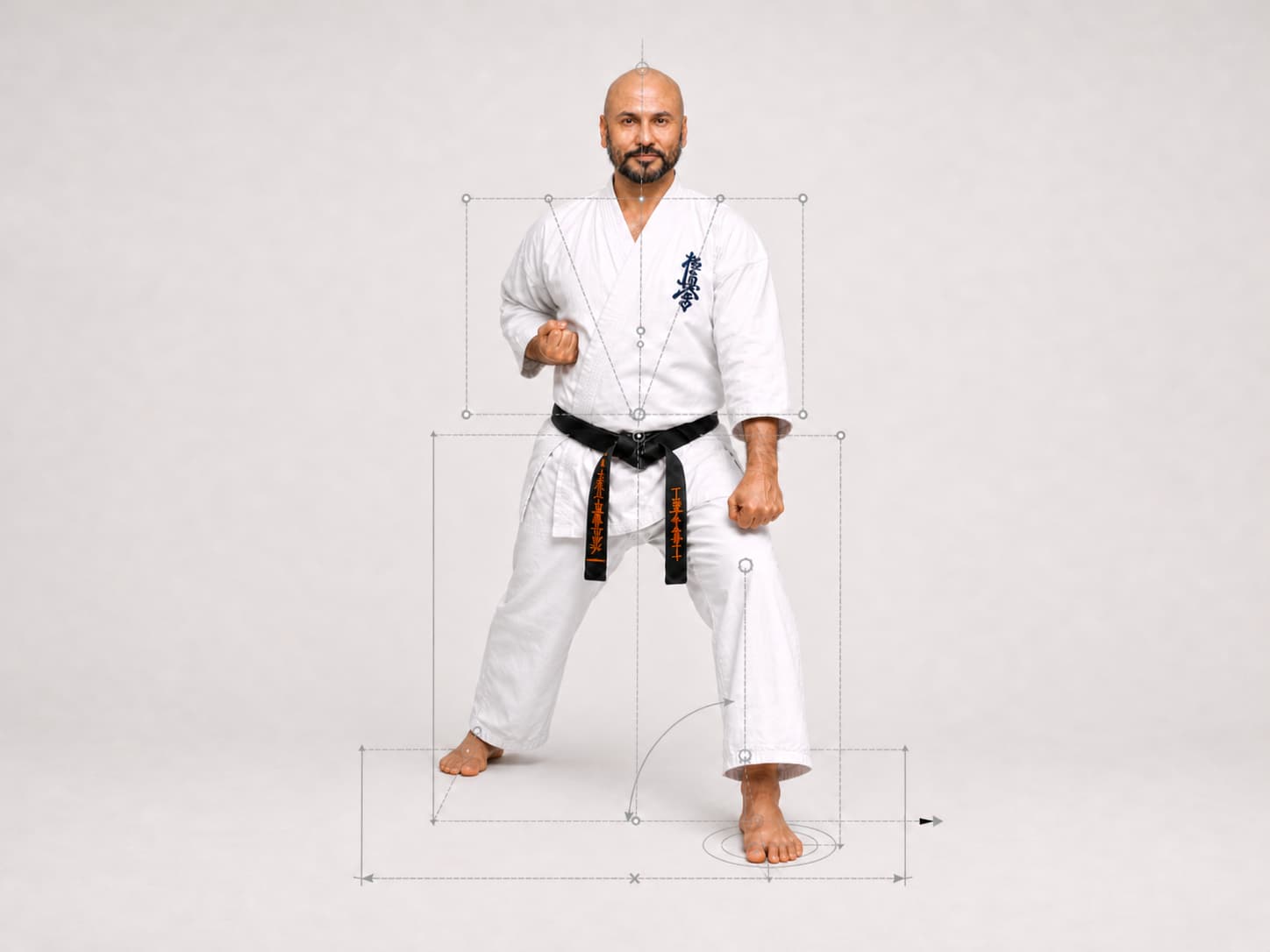
Place the front foot clearly ahead and point it in the direction of technique. Keep the rear foot on the floor and angle it slightly outward. The stance must be long enough to create forward direction without locking the hips.
Legs
Bend the front knee in line with the front foot. Keep the rear leg straight or strongly extended and active.
Hips
Lower and organize the hips between the feet. Forward direction must come from the whole stance, not from collapsing the upper body.
Trunk and spine
Keep the trunk strong and collected. A slight forward character may exist, but do not break at the waist.
Shoulders, arms, and hands
Relax the shoulders. Arm position follows the technique. Common kihon combinations include gedan barai, oi-tsuki, jōdan uke, chūdan soto uke, and chūdan uchi uke.
Gaze
Look forward in the direction of technique.
Weight distribution
For teaching purposes use approximately 70% front / 30% rear. The rear leg must remain active rather than empty.
Center of gravity and balance
Keep the center low, active, and directed forward. The stance should be stable without becoming heavy or locked and should permit the next step, turn, or technique without first rescuing balance.
Technical purpose
Zenkutsu-dachi develops:
- forward-directed body structure
- coordination of feet, hips, and technique
- stability during stepping
- active use of the rear leg
- a lowered center without rigidity
- clear force transfer in forward techniques
Use
Basic training
Train the relationship between foot, knee, hip, trunk, and technique.
Kihon / Idō geiko
Use it extensively for techniques performed while stepping forward or backward and for training direction, timing, and coordination.
Kata
It is common in Kyokushin kata and carries blocks, strikes, and directional changes.
Kumite / application
In free fighting the stance is normally shorter and less formally marked, but its principle remains whenever the body drives forward in attack, defense, or counterattack.
Technical key points
- clear front/rear foot relationship
- front foot forward, rear foot slightly outward
- front knee bent and aligned
- rear leg strong and extended
- hips lowered without locking
- center directed forward under control
- trunk organized, not falling forward
- rear leg active
Common errors
- stance too short or too long
- front knee collapsing inward
- rear leg too bent or passive
- rear foot turned too far outward
- weight centered instead of directed forward
- leaning from the waist
- excessive shoulder tension
Comment
Zenkutsu-dachi is one of Kyokushin’s principal basic stances. It joins footwork, hips, center of gravity, and technique into a clear model of forward-directed force.