Skip to content

Kake-dachi

Name

Kake-dachi (掛け立ち)
Hooked stance


Introduction

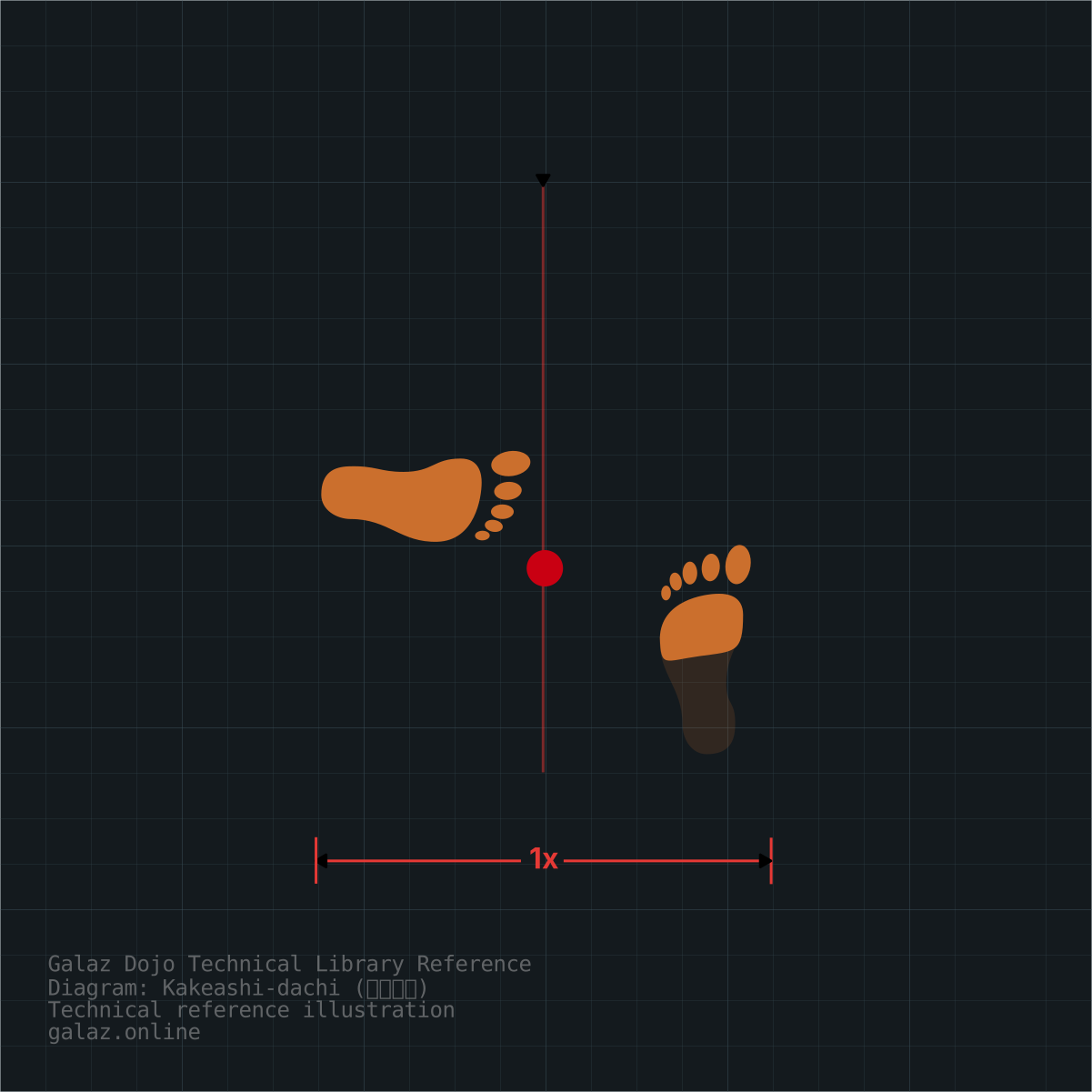
Kake-dachi is a specialized stance in which one leg is crossed and hooked behind the other, so that the body is carried mainly over the supporting leg while the rear, hooked leg helps lock and stabilize the form.

In Masutatsu Oyama’s Vital Karate and This is Karate, hooked stance is described very briefly and clearly: the left foot is hooked behind the right foot, most of the body’s weight is placed on the right leg, and only the toes or forepart of the left foot are turned inward. This shows that Oyama sees kake-dachi as a relatively simple but clearly defined special stance.

In later Kyokushin material, the stance is developed more practically. Howard Collins describes how one enters kake-dachi from fudo-dachi, how the rear leg locks behind the front one, how 90 percent of the weight lies on the supporting leg, and how only the ball of the rear foot has contact with the floor. He also shows how the stance can be used in movement and turning. This makes kake-dachi more than a static form: it becomes a real technical stance for locking, direction, and transition.

Kake-dachi therefore belongs to the specialized stances in Kyokushin. It is less central in basic training than zenkutsu-dachi, kokutsu-dachi, or sanchin-dachi, but important for the completeness of the system, for certain kata sequences, and for understanding how the body can be carried in a hooked, locking structure.


Definition

Kake-dachi is an asymmetrical stance in which one leg is crossed behind the other, so that the weight is carried mainly by the front supporting leg while the rear leg functions as the hooking and stabilizing leg.

The stance is characterized by:

  • crossed leg position
  • main weight on one leg
  • rear leg hooked behind the front leg
  • compact and locking structure
  • clear direction through the hip and shoulder
  • limited but usable base

Structure / form

Feet

  • the starting point may be taken from a neutral stance such as fudo-dachi
  • one foot is kept as the supporting foot in front
  • the other foot is brought behind the supporting leg
  • only the front foot is kept fully flat on the floor
  • the rear leg’s foot has contact mainly through the ball or front part of the foot

Howard Collins describes this clearly: the right foot is kept flat on the floor while only the ball of the left foot has contact with the surface.

Legs

  • the rear leg is hooked behind the front leg
  • the front of the rear knee is placed behind the front leg
  • the supporting leg carries the greater part of the weight
  • the hooked leg helps lock the stance and prevent loss of balance

Oyama’s own description is very short: the left foot is hooked behind the right foot and the greater part of the body’s weight is placed on the right leg. Collins develops this by describing how the actual “locking” in the legs stabilizes the forward movement.

Hips

  • the hips are kept organized over the supporting leg
  • the side corresponding to the supporting leg will naturally point somewhat forward in the intended direction of movement
  • the body must not twist uncontrollably or fall to the side

Collins points out that because the rear leg lies behind the front one, the hip and shoulder on the supporting-leg side will point in the direction of movement. This is an important practical key to the stance’s direction.

Torso and spine

  • the spine is kept upright
  • the body should be gathered over the supporting leg
  • the upper body must not lean sideways to “save” the balance
  • the stance should feel locked but still alive

Arms and hands

When the stance is trained as pure form:

  • the arms may be held neutrally

When it is used in kata or technique:

  • the position of the arms is determined by the demands of the technique

In John Taylor’s kata presentation, kake-dachi appears, for example, as the base for yama-tsuki and other clearly marked techniques, which shows that the stance can carry active hand forms despite its specialized base.

Gaze

  • the gaze is kept in the direction of the technique or movement
  • the head is held upright and gathered

Weight distribution

Kake-dachi is carried mainly on the supporting leg.

Oyama expresses this by saying that the greater part of the body’s weight lies on the right leg when the left leg is hooked behind. Howard Collins specifies this as approximately:

  • 90% on the supporting leg
  • 10% on the hooked leg

It is therefore reasonable to understand kake-dachi as a clearly one-leg-dominant stance, even though the rear leg still has an active stabilizing function.


Center of gravity and balance

The center of gravity is kept gathered over the supporting leg.

Because the base is narrower and more locked than in many other stances, kake-dachi requires especially good balance. The hooked leg gives support, but does not fully carry the body. The stance therefore trains:

  • balance over one primary supporting side
  • control in a crossed leg structure
  • hip and leg coordination
  • the ability to maintain direction in a narrower base
  • stability in locked movement

Kake-dachi should not feel like a temporary misstep, but as an intentional and controlled form.


Technical purpose

Kake-dachi is used to create a hooked and locking stance in which the body can be kept gathered over one leg while the other leg provides support and structure.

Its technical purpose is to:

  • develop control in crossed leg positioning
  • train balance in locked asymmetry
  • give particular direction to the hip and shoulder
  • function as a special stance in certain kata and transitions
  • create compact stability in certain short technical situations

The stance is therefore not a general main stance for all basic technique, but a more specialized part of the system.


Use

Basic training

Kake-dachi is used to train:

  • crossed leg structure
  • balance over the supporting leg
  • control in narrow asymmetry
  • locking and direction in hip work

Movement

Howard Collins describes how one walks in kake-dachi by first moving the weight, then stepping forward with the supporting foot about one shoulder width, and then locking the other leg behind again. He also stresses that the movement should be dynamic and compares it to stamping on someone’s foot. This shows that kake-dachi can be more active in movement than one might first think.

Turning

In the same Kyokushin material, it is described how one turns in kake-dachi by keeping the feet in the same mutual relation, turning the head 180 degrees, and then letting the first step after the turn change the side of the hooked structure. This shows that the stance has its own turning logic.

Kata

Kake-dachi occurs in kata and is then often used as a marked special stance in transitions or before certain techniques. In John Taylor’s kata presentation, for example, it is used in combination with morote-tsuki and as a clearly locked position after a jump or change of direction.


Relation to other stances

Kake-dachi differs clearly from the system’s main stances.

  • in relation to fudo-dachi, it is hooked and locked instead of neutral
  • in relation to nekoashi-dachi, it is not only rear-weighted but also crossed
  • in relation to tsuruashi-dachi, it has more support through both legs, but less open balance
  • in relation to moroashi-dachi, it is not parallel but hooked

Kake-dachi is therefore especially valuable for understanding how Kyokushin also works with more compact and unusual leg structures.


Technical key points

  • the rear leg is hooked behind the supporting leg
  • the greater part of the weight is kept on the supporting leg
  • the front foot is kept flat on the floor
  • the rear foot has contact mainly through the ball of the foot
  • the body is kept gathered over the supporting leg
  • the hip and shoulder are clearly directed
  • the stance should feel locked but not stiff
  • the balance must not be saved with the upper body
  • the gaze is kept in the direction of movement

Common mistakes

Too much weight is placed on the rear leg

Then the stance’s clear primary support is lost.

The rear leg is not clearly hooked behind

Then the stance becomes unclear and loses its hooked character.

The front foot lifts or turns uncontrollably

The supporting leg must be stable and clearly anchored.

The body leans to the side

This is a common error when balance is not yet fully developed.

The hip loses direction

Kake-dachi should not only be crossed legs; it should also carry the body in a clear technical direction.

The stance becomes passive

The hooked form should be actively carried, not merely arranged.


Comment

Kake-dachi is a small but important stance in Kyokushin.

In Oyama, it is defined simply: one foot is hooked behind the other, the greater part of the weight lies on the supporting leg, and the toes of the hooked leg turn inward. In later Kyokushin material, it becomes clear that this simple form contains more than it first appears to. Kake-dachi trains balance, locking, direction, and compact structure, and gives the system a special type of asymmetry that the larger main stances do not provide.